
California's Department of Cannabis Control (DCC) cultivation and sanitation package took effect on July 1, 2026. It applies to cultivators and to any licensee that cultivates, processes or packages cannabis, so written procedures should be checked against the rule text now rather than during an inspection.
The package is DCC-2025-01-R. DCC approved and filed it with the Secretary of State on April 28, 2026, after four rounds of modified text. The approved text, not the original proposal, is the version to work from.
Fall harvest puts these standards under the most pressure. More harvest batches move through drying, trimming and packaging at the same time, which means more between-batch cleaning, more containers to sanitize or line, and more hands on unpackaged cannabis.
What changed in the cultivation package
DCC's summary lists several operational changes alongside the new sanitation rules. Each harvest batch must have a unique name recorded in the track-and-trace system, be separated from other batches by an identifiable boundary, and be labeled where a worker standing beside it can see the label. Temporary cannabis events can now run up to 30 consecutive days. Cultivators can transfer immature plants and seeds to a nursery or to another cultivation premises they own. DCC also removed the requirement to submit a pest management plan with an application, and it dropped the electricity reporting and carbon offset purchase tied to renewal.
The deletions remove some paperwork, but the sanitation standards add daily work. Read the approved text for the exact wording of each section.
Daily cleaning and sanitizing
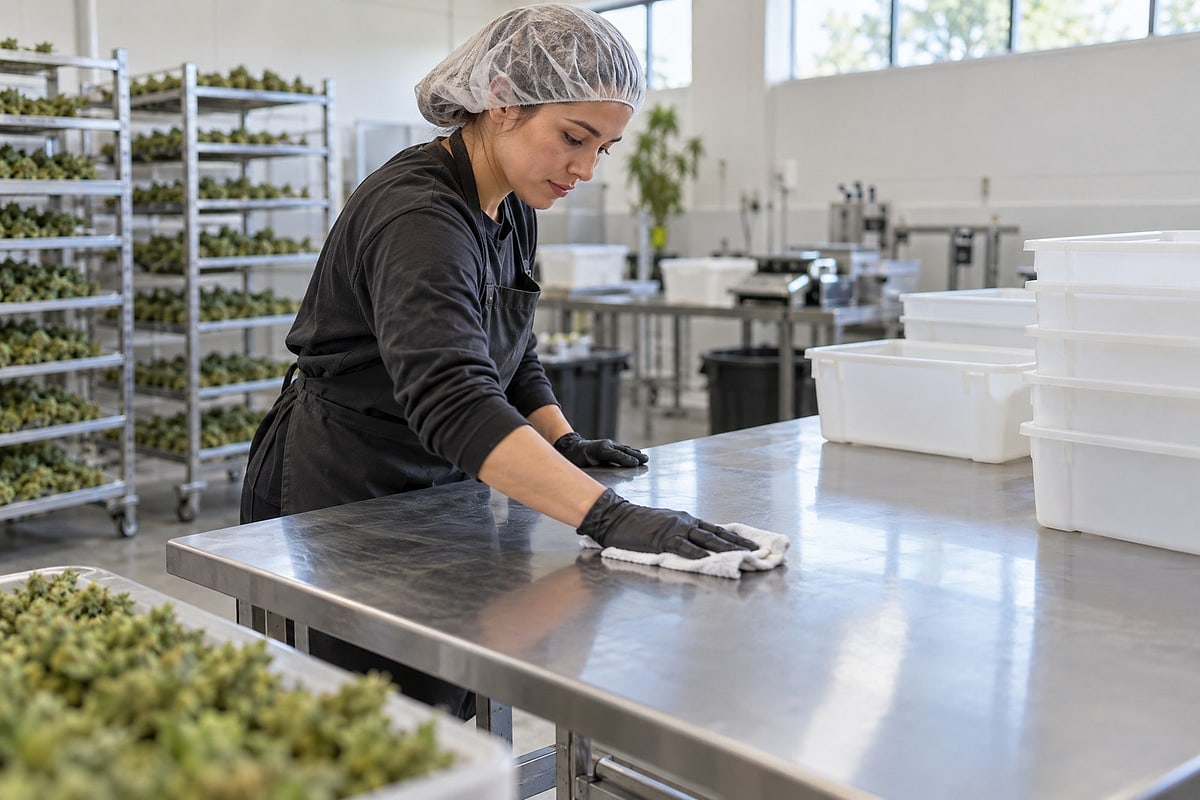
Section 15061 requires that tools and utensils used to process cannabis or package it for retail be cleaned and sanitized each day they are in use, and between work on different harvest batches. The rule names scissors, funnels, sieves and sifters. Equipment surfaces that touch processed or unpackaged cannabis, including trimmers, sorters, rolling machines, tables, tarps and trays, follow the same daily cycle. Any container used to store or move processed cannabis must be cleaned and sanitized, or lined with a new single-use liner, before each use.
The rule defines clean as free of visible dust, dirt, debris, cannabis residue and food residue. Sanitize means immersion, manual scrubbing or brushing with a chemical sanitizer that meets 40 CFR 180.940, used according to the manufacturer's directions. Your written procedure should name the sanitizer, the dilution and the contact method you actually use.
Handwashing, gloves and animals
Section 15062 requires that anyone who processes, packages or otherwise handles unpackaged cannabis has access to either a handwashing station with running water, soap, paper towels or an electric dryer and a waste container, or single-use, food-safe, non-latex gloves. Before each task, a worker must either wash hands for at least 15 seconds or put on new gloves. If you rely on gloves rather than sinks, stock them at each station so a fresh pair is always within reach.
Section 15060 bars animals, other than service animals, from indoor areas where unpackaged cannabis is present and from outdoor areas used for processing or packaging. Animal waste within 30 feet of plants or harvested cannabis must be removed immediately upon discovery, except manure used as fertilizer.
Pesticide labels can affect every product on site
Section 15070 is the provision most likely to surprise operators. Possessing a pesticide product on a licensed premises that is not labeled under 40 CFR 156.10(a)(3) makes all cannabis and cannabis products on that premises held under unsanitary conditions, for purposes of Business and Professions Code section 26039.6(a)(1). One unlabeled container can therefore reach the whole inventory, not only the product it was used on.
The simplest way to stay clear of this is to keep every pesticide product in its original, labeled container, and to remove or replace any container whose label is missing or unreadable.
Transfers still go through a licensed distributor
Section 16202 prohibits cultivators from transferring commercially cultivated cannabis off their licensed premises except through a distributor licensed by DCC. Section 16300 applies the same route to immature plants and seeds moving to a licensed nursery, and to moves between a licensee's own cultivation premises. Confirm that every shipment, including internal moves between your own sites, is documented under a licensed distributor.
What to do now
- Compare your standard operating procedures against sections 15061 and 15062, and add daily tool and equipment cleaning, between-batch cleaning, and container sanitizing or liner steps to a log.
- Inventory every pesticide on site, check each label against 40 CFR 156.10(a)(3), and quarantine anything that does not match.
- Confirm handwashing stations or single-use gloves are available at every handling step, and that staff know the 15-second rule.
- Review transfer records for plants, seeds and harvested cannabis to confirm each move used a licensed distributor.
- Check any planned temporary event against the new 30-day limit before you commit dates.
If you want a second review of your procedures before an inspection, you can book a consultation or call (209) 636-4856.
Sources
- DCC-2025-01-R: Cultivation Updates; Sanitation Standards — California Department of Cannabis Control
- DCC-2025-01-R: Cultivation Updates; Sanitation Standards, Final Text — California Department of Cannabis Control
- DCC Rulemaking — California Department of Cannabis Control
This article provides general educational information and does not constitute legal advice. Consult qualified counsel regarding specific facts or jurisdictional requirements.